
If you’re opening, renovating, or moving into a commercial space in California, ADA-compliant signage isn’t optional — and California’s requirements are stricter than federal law. The state’s building code (Title 24) layers additional rules on top of the Americans with Disabilities Act, which means a sign that passes federal inspection can still fail in California. Here’s what actually triggers a requirement, what compliant signs look like, and what it costs in the Bay Area.
What Triggers an ADA Sign Requirement?
Not every sign in your business needs to be ADA-compliant — only signs that identify permanent rooms or spaces.
That includes:
- Room identification signs — offices, conference rooms, restrooms, exits, stairwells
- Directional and informational signs that are permanently mounted
- Elevator signs — floor numbers, call buttons, door jamb plates
- Accessible route signage — the International Symbol of Accessibility where required
Temporary signs, promotional displays, menu boards, and window graphics are exempt. If a sign is directing someone to a fixed location that will exist in the same spot for the life of the building, it likely needs to comply.
The Key Requirements (Federal ADA + California Title 24)
Tactile Characters and Grade 2 Braille
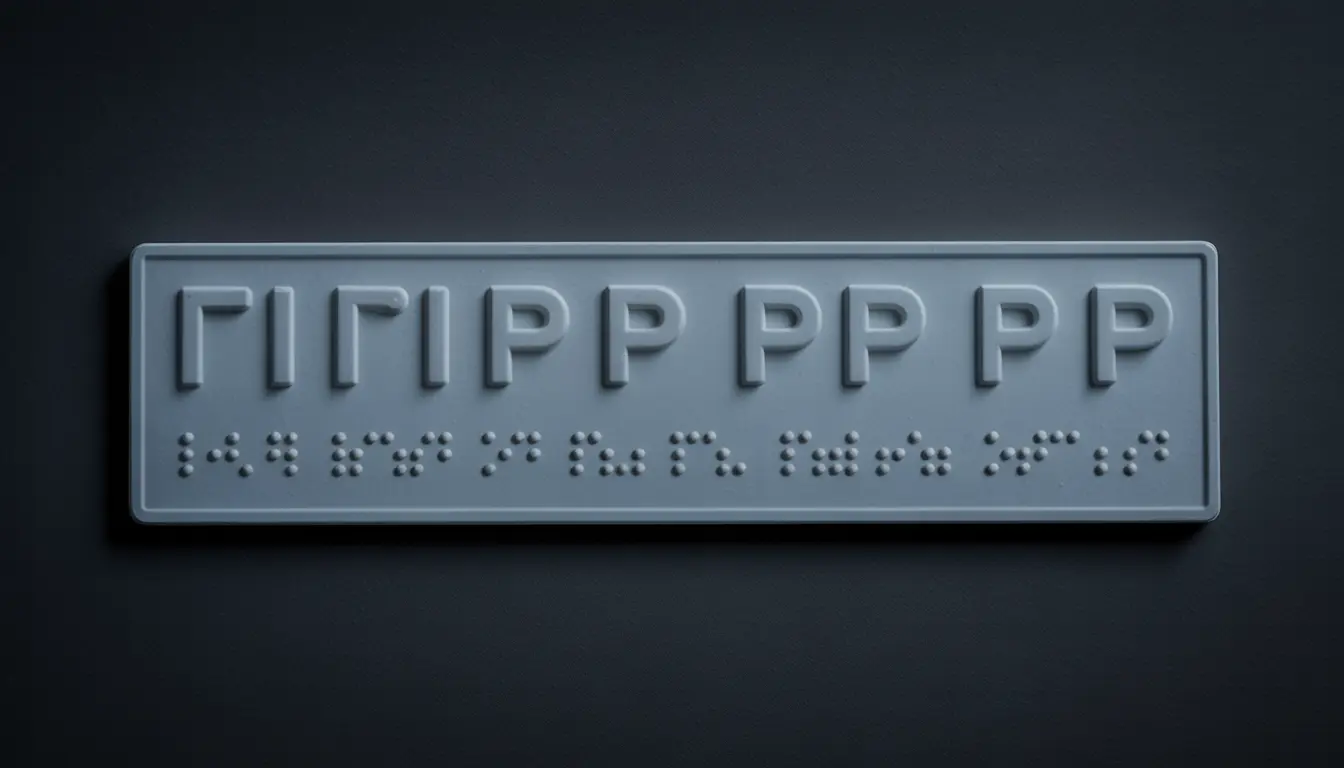
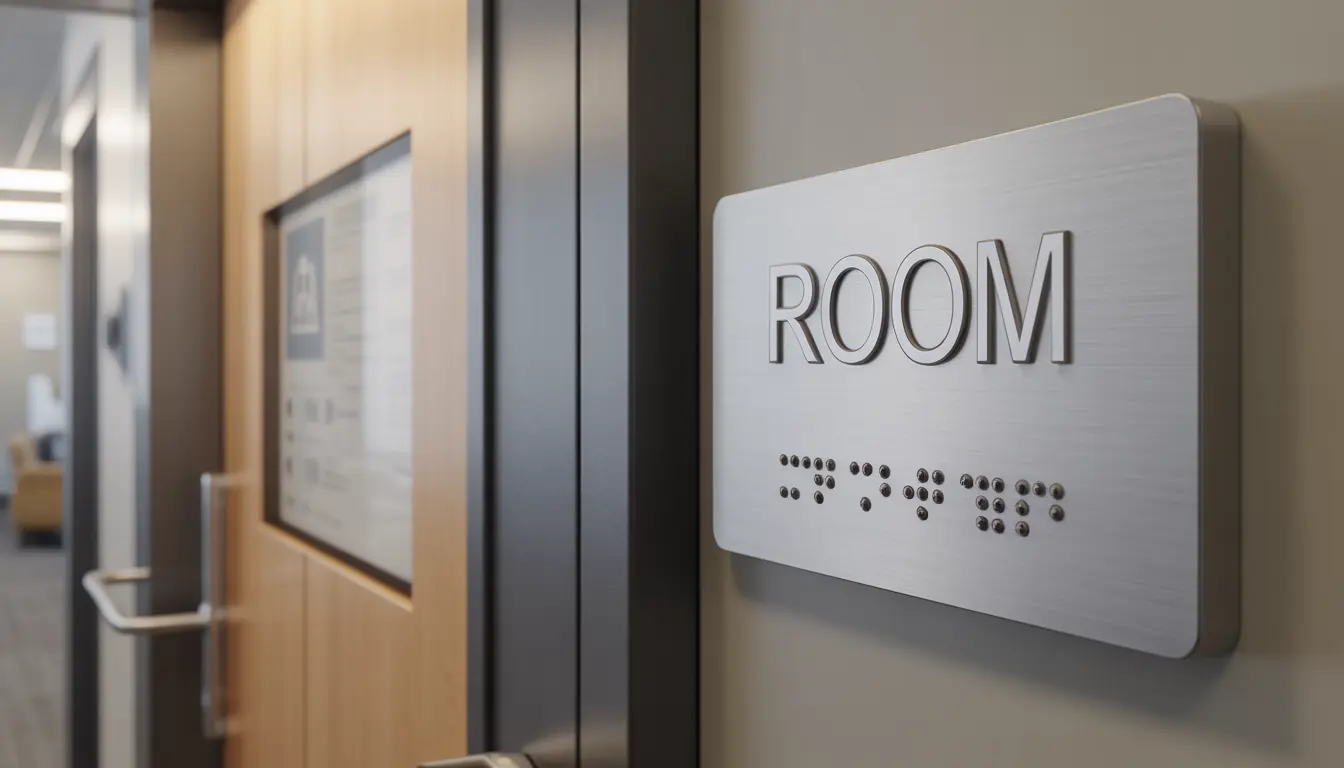
Room ID signs must include raised (tactile) uppercase letters and Grade 2 Braille. The tactile characters need to be between 5/8" and 2" tall, with a specific raised profile — flat-cut acrylic letters don’t qualify. Grade 2 Braille (contracted Braille, not dot-for-dot) must appear below the tactile text.
California Title 24 adds a requirement that’s easy to miss: the Braille must be positioned immediately below the tactile text, with a specific spacing tolerance. Signs manufactured to federal spec alone often don’t meet this.
Mounting Location and Height
This is where most violations occur. ADA-compliant room ID signs must be mounted:
- On the latch side of the door (the side opposite the hinges)
- Centerline of the sign at 60 inches from the floor
- With at least 18 inches of clear floor space on the latch side for approach
If there’s no room on the latch side — for example, if the wall is less than 12 inches wide — you can mount on the nearest adjacent wall, but specific rules apply. Measure your latch-side clearances before ordering, not after.
Finish and Contrast
Characters and symbols must contrast with the sign background by at least 70% — light on dark, or dark on light. Glare is also regulated: signs must have a non-glare finish. Highly polished metal or glossy acrylic backgrounds won’t pass unless the characters still achieve the contrast threshold.
California also requires that pictograms (where used) be accompanied by a text descriptor in tactile characters — not just the symbol alone.
Symbol of Accessibility
Where accessible features exist — accessible restrooms, accessible parking, accessible entrances — you’re required to post the International Symbol of Accessibility. California has its own updated version of this symbol. The older static version is still technically valid under federal law, but California’s updated dynamic symbol is recommended for all new installations.
What Does ADA-Compliant Signage Cost in the Bay Area?
Pricing varies by material, quantity, and complexity. Here’s a realistic range for Bay Area commercial projects:
| Sign Type | Typical Range |
|---|---|
| Standard ADA room ID sign (restroom, office) | $45 – $120 per sign |
| Elevator tactile signs (floor numbers, jamb plates) | $60 – $150 per sign |
| Braille + tactile wayfinding signs | $75 – $200 per sign |
| Full suite (10–20 signs, one location) | $800 – $2,500+ |
Material choice matters. Photopolymer (resin-cast) and raster (bead-blasted acrylic) are the two most common ADA-compliant tactile production methods. Photopolymer is more precise and durable; raster is less expensive at higher quantities. Both are compliant when produced correctly.
For multi-tenant buildings or medical offices with a higher sign count, the per-unit cost drops with volume. When getting quotes, ask vendors to specify the production method — not all sign shops produce ADA signs in-house, and outsourced production adds lead time.
Use our AI Pricing Estimator → to get a ballpark for your specific scope before reaching out.
Do ADA Signs Require a Permit in San Jose or Santa Clara County?
For interior ADA signage — room IDs, restroom signs, directional signs — a standalone sign permit is generally not required. That said:
- If you’re doing tenant improvements (TI work), ADA-compliant signage will be part of the construction document review and must be called out on the plans
- If your renovation triggers an accessibility upgrade requirement (common once TI costs exceed a certain threshold), non-compliant existing signs may need to be replaced as part of the project scope
- Exterior accessible parking signs and accessible route markers may be reviewed during site plan approval
The City of San Jose uses CBC Chapter 11B for accessibility, which incorporates California Title 24 requirements. Santa Clara, Sunnyvale, Milpitas, and Campbell follow the same state code. When in doubt, your architect or the building department’s permit counter can confirm whether your specific scope triggers a review.
Common Mistakes to Avoid
Ordering signs without field-verifying mounting locations. Online ADA sign vendors ship compliant signs, but a compliant sign installed in the wrong location is still a violation. Measure latch-side clearances before placing your order.
Using flat acrylic letters as tactile characters. Flat laser-cut or routed letters don’t meet the required tactile profile. Characters must be raised a specific amount and rounded in cross-section — this is a fabrication spec, not just a visual preference.
Skipping Braille on “obvious” rooms. There’s no exemption for spaces that seem self-explanatory. A restroom still needs Braille. A storage room not accessed by the public may be exempt, but when in doubt, include it.
Mismatched signage during renovations. If you replace some signs and not others, inspectors may flag the older non-compliant signs as part of the same project scope.
FAQ
Do all businesses in California need ADA signs? Any business open to the public occupying a fixed commercial space is subject to ADA and Title 24 requirements. This includes retail, medical and dental offices, professional services, restaurants, and office buildings. Any space where clients or employees physically enter is covered.
What’s the difference between federal ADA and California Title 24 for signs? Federal ADA sets the baseline. California Title 24 (Chapter 11B of the California Building Code) is more stringent in several areas — particularly Braille placement, pictogram descriptor requirements, and the accessible symbol standard. California compliance satisfies federal ADA, but not always the reverse.
Can I use printed Braille stickers on existing signs to bring them into compliance? No. Stick-on Braille dots are not considered compliant by California inspectors. Braille must be produced as an integral part of the sign surface. If you have non-compliant signs, they typically need to be replaced, not patched.
How long does it take to get ADA signs made? Standard production for photopolymer or raster ADA signs is typically 5–10 business days, depending on quantity and complexity. For tenant improvement projects with a hard move-in date, order early — don’t leave signage for the final week.
What happens if my business isn’t ADA-compliant? Non-compliant businesses are exposed to complaints filed with the Department of Justice, lawsuits under the ADA, and in California, civil rights claims under the Unruh Act — which allows for minimum statutory damages per violation. California has a relatively active ADA litigation environment. Getting signage right is a low-cost way to remove a real liability.
Do restroom signs need to indicate gender, or can I use a generic “Restroom” sign? Gender-neutral single-occupancy restrooms can use a generic “Restroom” sign with the accessible symbol where applicable. Multi-stall facilities still require gender designation. All of them require tactile characters and Grade 2 Braille regardless of the designation used.
Ready to Get Your ADA Signs Done Right?
Clear Line Signs produces ADA-compliant tactile signs for Bay Area commercial projects — tenant improvements, medical offices, dental practices, and multi-tenant buildings. We handle both fabrication and installation, and we’ll confirm mounting locations with you before anything goes on the wall.
Use our AI Pricing Estimator for a ballpark instantly, or fill out a design brief and we’ll come back with a full quote — no obligation, no sales pressure.
Sources
- ADA Standards for Accessible Design — U.S. Department of Justice
- California Building Code, Chapter 11B — Accessibility — Division of the State Architect
- Disability Access Improvement Grant Program — City of San José
Last reviewed: September 18, 2026