
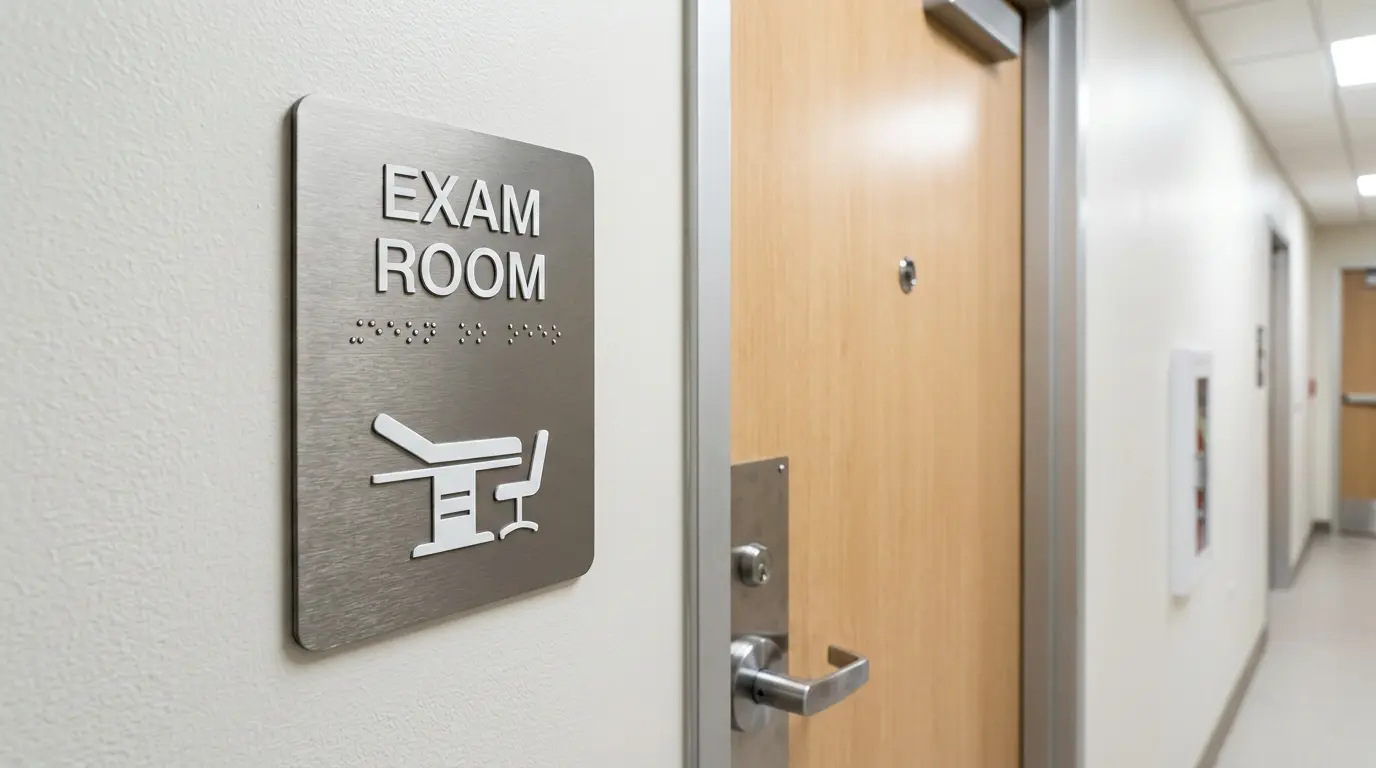
California’s ADA signage requirements are stricter than federal minimums, and medical offices have specific requirements that go beyond what most general commercial tenants face. If you’re opening a new practice in San Jose, going through a tenant improvement, or managing a healthcare facility that hasn’t had a signage review recently, this is what Title 24 actually requires.
Federal ADA vs. California Title 24 — The Difference Matters
Federal ADA sets the floor for accessibility requirements across the country. California Building Code Title 24, Part 2 — the California Accessibility Standards — goes further in several specific areas. California’s requirements apply in addition to federal ADA, not instead of it. Where there’s a conflict, the more restrictive standard applies. For medical offices in San Jose, that almost always means Title 24 governs.
The areas where California differs most significantly from federal ADA for signage:
Restroom sign geometry — Federal ADA requires a sign with tactile characters and Braille. California Title 24 requires specific geometric shapes on single-occupancy restroom doors: an equilateral triangle pointing up for men, a circle for women, and a triangle superimposed on a circle for all-gender or gender-neutral restrooms. These shapes must be in addition to the tactile text and Braille.
Contrast requirements — California specifies a minimum 70% contrast ratio between characters and background. Federal ADA requires “high contrast” without a specific percentage. In practice, California’s 70% threshold is measurable and enforceable in a way the federal standard is not.
Character sizing — Both standards require tactile characters between ⅝" and 2" high. California is more specific about stroke width and spacing requirements that affect which fonts are compliant.
What Signs Are Required in a California Medical Office
Under California Title 24 CBC §11B-703, any permanent room or space that is not open to the general public but is used by occupants requires a tactile and Braille room identification sign. For a typical medical office, the complete list includes:
Rooms that require signs regardless of use:
- All restrooms
- All stairwells — floor identification sign at each landing, on the latch side of the stairwell door
- Elevator lobbies — floor identification at each level
- Mechanical, electrical, and utility rooms
- Storage rooms and supply closets
- Janitorial closets
Rooms specific to medical facilities:
- Exam rooms — each room requires a tactile room ID sign even if the room is identified only by number
- Procedure and treatment rooms
- Consultation rooms — private offices used for patient consultations require signs
- Staff areas — break rooms, private offices, conference rooms used by staff but not the general public
Commonly missed:
- The exit discharge side of stairwell doors — requires a tactile “EXIT” sign at each level
- Accessible restroom — requires the International Symbol of Accessibility (ISA) in addition to the standard restroom sign
- Areas of rescue assistance — if your building has a multi-story component, areas of rescue assistance require specific signage per CBC §11B-703.8
Technical Specifications for Each Sign
Tactile characters (CBC §11B-703.2)
- Raised minimum 1/32" from the sign face
- Uppercase only
- Sans-serif typeface — no scripts, no italic, no condensed or extended variants
- Character height between ⅝" and 2"
- Character width between 55% and 110% of character height
- Stroke width between 15% and 30% of character height
Grade 2 Braille (CBC §11B-703.3)
- Contracted (Grade 2) Braille required — not uncontracted Grade 1
- Located directly below the corresponding tactile text
- Separated from the bottom of the tactile text by a minimum of ⅜"
- Braille dots must be domed, not flat
Finish and contrast (CBC §11B-703.5)
- Non-glare finish required on characters, pictograms, and background
- Minimum 70% contrast between characters and sign background
- Eggshell, matte, or satin finishes are standard compliant options
- High-gloss is non-compliant regardless of contrast ratio
Pictograms (CBC §11B-703.6)
- Pictogram field (the symbol itself) must be at least 6" high
- Accompanied by the equivalent text description in tactile characters and Braille
- Non-glare finish and contrast requirements apply to pictograms
Mounting Requirements
Location (CBC §11B-703.4.1)
- Must be mounted on the wall adjacent to the latch side of the door
- Where there is no wall space on the latch side, may be placed on the nearest adjacent wall
- For double-leaf doors: mount on the right-hand door
Height (CBC §11B-703.4.2)
- Baseline of the lowest tactile character between 48" and 60" above finished floor
- This is measured to the baseline of the characters, not the bottom of the sign
Clear floor space (CBC §11B-703.4.3)
- 18" x 18" clear floor space centered on the sign
- Nothing may obstruct approach to the sign within this space — no furniture, no door swing interference
What Happens at Inspection
For new medical office build-outs in San Jose, ADA signs are inspected as part of the Certificate of Occupancy process. The inspector will verify:
- That all required rooms have compliant signs
- That signs are mounted on the correct side of the door at the correct height
- That Braille is accurate and properly formed
- That contrast and finish requirements are met
- That restroom signs include the correct California geometric shapes
Non-compliant signs or missing signs at inspection result in a correction notice — the CO is withheld until the issue is resolved. This is a common and entirely avoidable delay in medical office build-outs.
The Practical Approach
The most efficient way to handle ADA signage for a medical office build-out is to bring in your sign company during the design phase, not after construction is nearly complete. A sign schedule produced from the floor plan — identifying every room that requires a sign, the sign type, and the mounting requirements — allows fabrication to happen in parallel with construction so signs are ready for installation as soon as the building is ready for them.
For existing facilities that haven’t had a compliance review, a room-by-room audit identifies what’s missing, what’s non-compliant, and what needs to be replaced. Most facilities that were permitted before California’s current Title 24 standards took effect have at least some signs that no longer meet current requirements.
We conduct compliance audits for medical offices across San Jose and Silicon Valley — producing a complete sign schedule and quote from the audit findings so you know exactly what’s required and what it costs before any fabrication commitment.
Request an ADA compliance audit for your San Jose medical facility →
Sources
- ADA Standards for Accessible Design — U.S. Department of Justice
- California Building Code, Chapter 11B — Accessibility — Division of the State Architect
- Disability Access Improvement Grant Program — City of San José
Last reviewed: September 18, 2026