
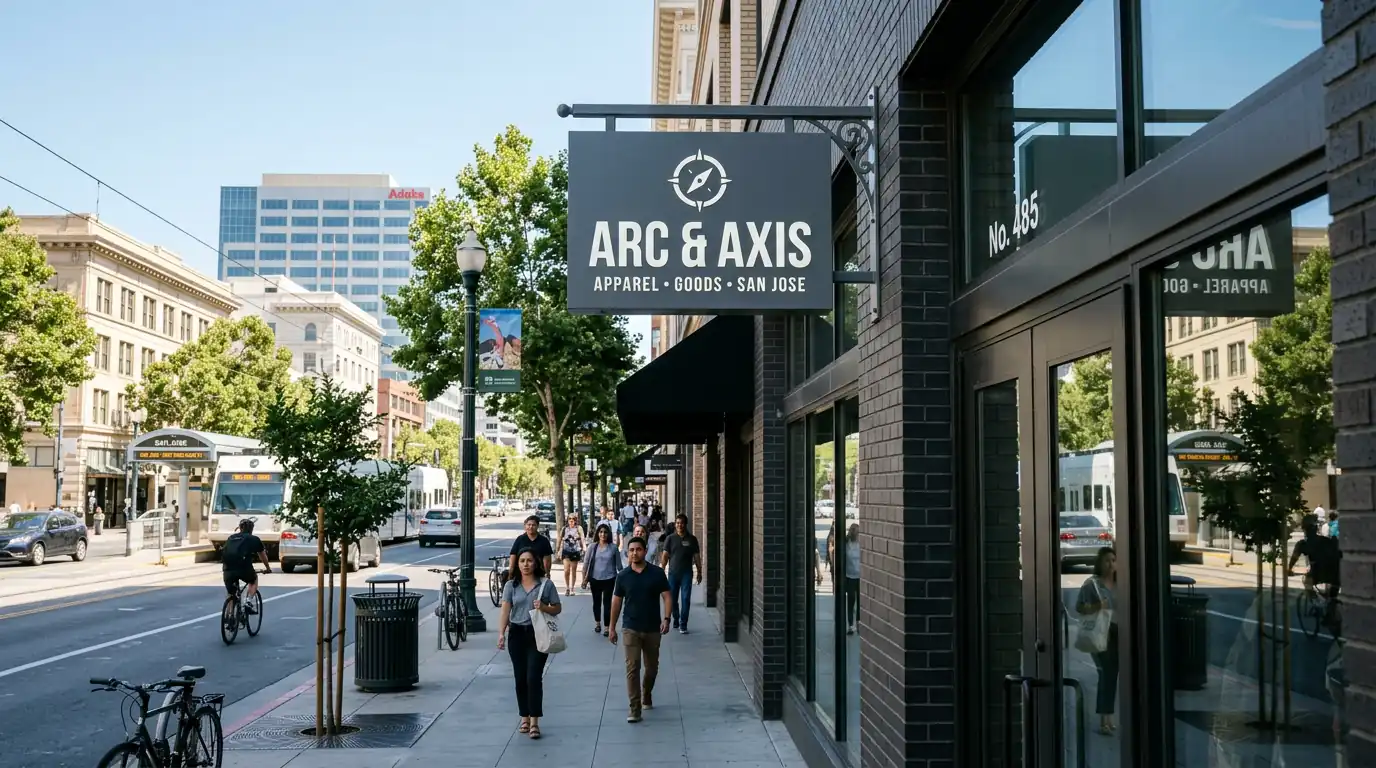
If you’ve searched for a sign that sticks out from the building — visible to foot traffic coming from either direction — you’ve probably seen both terms: blade sign and projecting sign. They refer to the same basic concept: a sign mounted perpendicular to the building face, extending over the sidewalk so it’s readable from down the block rather than just from directly in front.
The terminology varies by industry and region. Sign companies in California tend to say “blade sign.” Architects and permit departments often say “projecting sign.” Your landlord’s lease might say “hanging sign.” They all mean the same thing.
What actually matters isn’t the name — it’s understanding which configuration fits your building, your city’s sign code, and your business type.
Why Storefronts in San Jose Use Them
A flat fascia sign reads well when someone is standing directly in front of your storefront. Walk 30 feet down the sidewalk in either direction and it disappears into the building face. In a dense retail corridor — Downtown San Jose, Santana Row, Campbell Avenue, the Willow Glen stretch of Lincoln Avenue — pedestrians are already past your door before they see your name.
A blade sign solves that. Mounted at 90 degrees to the building, it reads to anyone approaching from either direction. For businesses where walk-in traffic matters — restaurants, retail, salons, medical offices with street-level access — that added visibility has a direct effect on foot traffic.
They also photograph well from the street, which matters for Google Maps listings, Yelp photos, and any marketing imagery of your storefront.
The Main Configurations
Illuminated cabinet blade sign — An aluminum box with translucent acrylic faces, internally lit with LED. The most common choice for businesses open into evening hours. Bright, weather-resistant, and visible day and night.
Flat panel blade sign — A non-illuminated aluminum or ACM panel, typically with applied vinyl or routed graphics. Cleaner and more minimal — suited to professional offices, boutiques, and buildings with restrictions on illuminated projecting signs.
Halo-lit blade sign — Dimensional letters or a logo mounted on a flat panel, backlit with LED for a halo glow effect at night. More upscale look for restaurants and premium retail.
Wood or HDU blade sign — A warmer, more handcrafted aesthetic using HDU foam or natural wood substrates with metal bracket hardware. Common in historic districts, cafes, independent restaurants, and neighborhood retail where the brand leans artisan rather than corporate.
Icon-only blade sign — A graphic shape rather than a text panel: a coffee cup, scissors, medical cross, wine glass. Fast visual shorthand that communicates the business type to someone in motion, without requiring them to read.
What the San Jose Permit Process Looks Like
Projecting signs in San Jose require a sign permit from the City’s Development Services Department. The permit application needs sign drawings showing dimensions, materials, mounting method, and clearance from the sidewalk (minimum 8 feet from grade per San Jose Municipal Code).
If the sign is illuminated, an electrical permit is also required. If the bracket attaches to a concrete or masonry wall, structural details may be requested.
On top of the city permit, most commercial leases require written landlord approval before any exterior sign installation. This is a separate process from the city permit — you need both before anything goes up.
The timeline varies, but most blade sign permits in San Jose take 4–8 weeks from submittal to approval. Factor that into your project timeline, especially if you have an opening date.
We handle the permit package and landlord approval submission as part of every blade sign project — drawings, dimensions, materials spec, and whatever the property manager needs to sign off. Most clients don’t have to deal with the city directly at all.
Choosing the Right Type for Your Building
A few factors that determine the right configuration:
Building construction — The bracket has to attach to something structurally sound. Wood-framed buildings, concrete tilt-up, and steel-stud construction all have different mounting requirements. We assess the wall before specifying hardware.
Lease restrictions — Many commercial leases specify allowable sign types, maximum projection dimensions, and whether illumination is permitted. Read your lease before you get attached to a specific sign design.
Zoning and historic district rules — Certain San Jose districts have specific design standards for projecting signs. Downtown San Jose has its own sign guidelines. We check these before design starts.
Sidewalk clearance — The bottom of the sign must clear at least 8 feet above the sidewalk grade. For low awnings or covered walkways, this can constrain sign height.
Brand aesthetic — An aluminum cabinet works for most businesses. A wooden blade sign in a tech office corridor looks out of place. Match the sign type to what the business actually is.
The Bottom Line
Blade signs work. For sidewalk-level storefronts in San Jose where foot traffic matters, they’re one of the highest-ROI exterior sign investments you can make. The permit process adds time compared to a flat storefront sign, but the visibility payoff is worth it for the right location and business type.
If you’re not sure whether a blade sign makes sense for your specific building and lease, the best first step is a site consultation — we’ll look at the building, check the lease restrictions, and give you an honest read on what’s possible and what it takes to get there.