
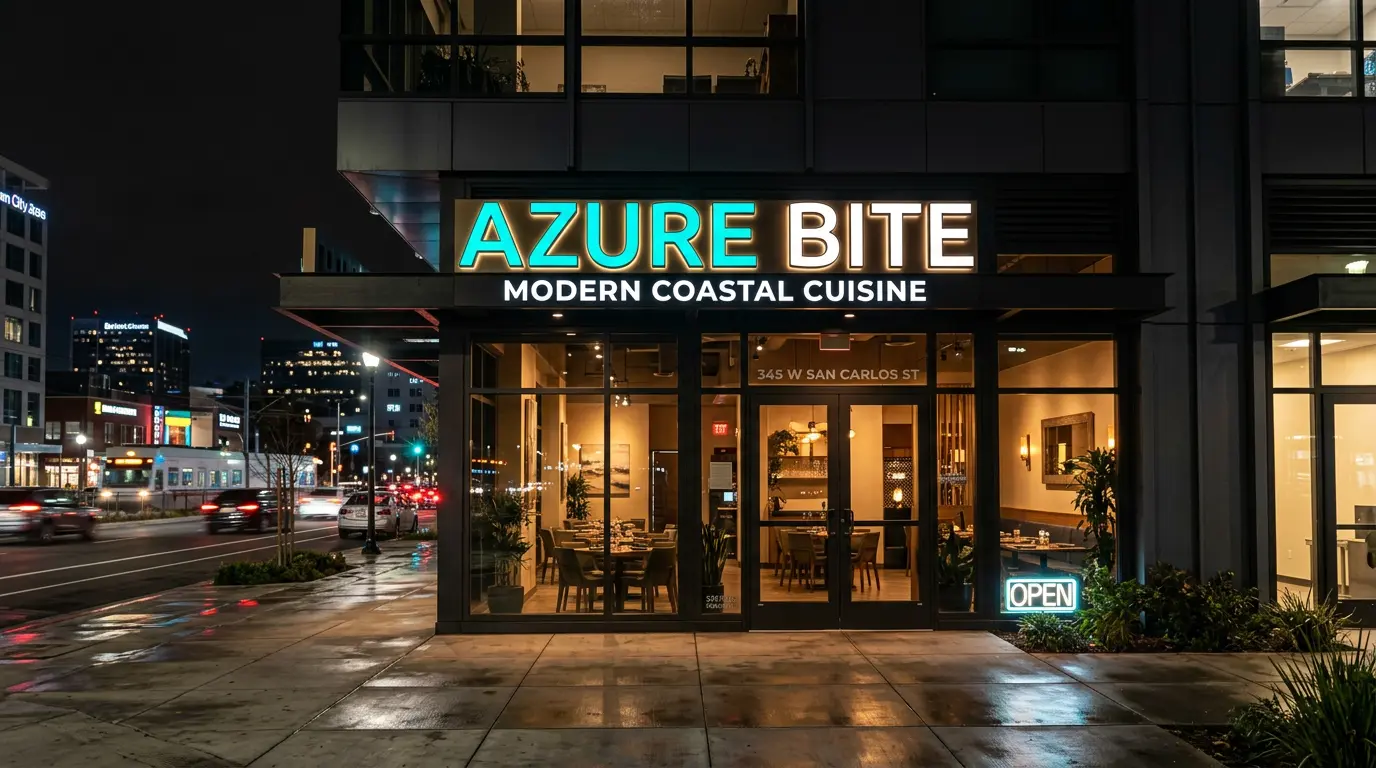
Channel letter signs in San Jose typically run $3,000–$20,000+, depending on letter size, illumination type, mounting method, and whether permit fees and electrical work are factored in. A small front-lit set for a single-tenant suite is on the lower end; a full halo-lit installation for a multi-building tech campus can push well past $15,000. Here’s what drives the cost and what Bay Area businesses are actually paying in 2026.
What Is a Channel Letter Sign?
Channel letters are individually fabricated, three-dimensional letters — each with its own aluminum housing, acrylic face, and internal LED lighting. They mount directly to a building face or to a raceway (an enclosed channel that hides the wiring). Unlike flat vinyl lettering or cabinet signs, channel letters project from the wall, creating depth and visibility that reads clearly from a distance in both daylight and at night.
Channel Letter Sign Pricing in San Jose
Here’s a realistic breakdown based on current Bay Area fabrication and installation costs:
| Configuration | Estimated Price Range |
|---|---|
| Non-illuminated dimensional letters, small set (under 24") | $1,500 – $3,500 |
| Front-lit channel letters, standard font, 24"–36" | $4,000 – $8,000 |
| Front-lit channel letters, 36"–48", complex logo | $7,000 – $12,000 |
| Halo-lit (reverse-lit) channel letters | $5,500 – $14,000 |
| Combination (front + halo) channel letters | $8,000 – $18,000+ |
| Large-format installation (multi-building, 48"+) | $12,000 – $25,000+ |
These ranges include design, fabrication, permit fees, and installation. They assume standard drywall or metal panel building faces — concrete, glass, or tile adds to installation cost.
What Drives the Cost Up (or Down)
Letter size is the dominant variable. Channel letters are priced primarily by the square footage of material — aluminum, acrylic, and LED modules — in each letter. A set of 48-inch letters uses roughly four times the material of a 24-inch set of the same font.
Illumination type has a major impact. Front-lit letters (standard) are the most cost-effective. Halo-lit letters require more precise fabrication, reflective returns, and specific mounting clearance from the wall. Combination illumination adds components from both. Open-face neon-style letters are a separate fabrication category and priced accordingly.
Number of letters and logo complexity matters. A clean five-letter wordmark in Helvetica is straightforward. A ten-character name with a multi-color logo mark, script lettering with thin strokes, or dimensional embellishments adds setup time and material handling at each step.
Raceway vs. direct mount changes the look and the cost slightly. Raceway-mounted letters are faster to install and required on some building types, but the raceway box is a visible element. Direct-mounted letters look cleaner architecturally but require individual conduit runs to each letter — more labor.
Mounting surface. Standard painted metal panel or stucco is the easiest and cheapest. Concrete requires hammer-drill anchoring. Glass or tile requires specialty hardware and sometimes a standoff bracket system. Factor in an additional $500–$2,000 for non-standard surfaces.
What Permits and Electrical Add to the Cost
This is where San Jose channel letter projects often surprise people who’ve gotten quotes from out-of-area vendors.
Sign permits in San Jose are required for virtually all exterior illuminated signs. The permit fee itself varies by project valuation — typically $300–$800 for a standard installation, more for larger projects requiring planning review. Permit preparation and submittal takes time, and revisions from the city add to the timeline.
Electrical work is a separate scope. Channel letters require a licensed electrician to make the final connection from the sign’s transformer to your electrical panel. Electrical costs in Silicon Valley run $600–$2,500 depending on the distance from panel to sign location, whether conduit needs to be run through finished walls, and whether the electrician needs to pull their own permit.
Combined permit and electrical costs of $1,500–$3,500 should be budgeted for a typical San Jose channel letter installation. Some sign companies include this in their quote; others scope it separately. Always ask before comparing bids.
Bay Area-Specific Factors
San Jose sign code governs the maximum area, height, and illumination level for signs in most commercial zones. Allowable sign area is typically calculated based on your building frontage and the zone type — San Jose’s sign regulations are worth reviewing before you design anything too large for your space. We pull the sign code for your specific address before designing.
Multi-tenant building restrictions are common across North San Jose, Downtown, and along the 101 corridor. Your lease may cap sign area, restrict illumination type, or require matching a center-wide sign program. Landlord approval is typically required in addition to the city permit — and some property managers have specific vendors or materials they want you to use. Get your lease addendum in hand before you engage a sign company.
HOA and CC&R restrictions apply to some commercial properties, particularly retail centers and mixed-use developments. These are separate from city permit requirements and don’t always align with what the city allows.
Installation access. If your building face requires a lift or scissor lift to reach — generally anything above 12–15 feet — equipment rental adds $400–$900 per day to installation cost. This is standard for second-floor or roofline installations.
How to Get an Accurate Quote
The information a sign company needs to give you a real number:
- Your building address — so we can pull the applicable sign code
- Your lease’s sign addendum or landlord approval contact
- Your logo file — vector preferred (.ai, .eps, .svg); raster files (.png, .jpg) work but limit accuracy
- Preferred illumination type — front-lit, halo, or combination
- Photos of the building face and any existing signage
With those in hand, most Bay Area sign companies can return a detailed quote in 1–3 business days. Production time for channel letters is typically 3–5 weeks from approved artwork, plus however long the permit takes — plan for 6–10 weeks from quote approval to installed sign in most San Jose jurisdictions.
FAQ
Are channel letters worth the cost compared to a cabinet sign? For most single-tenant storefronts and office buildings, yes. Channel letters have a higher perceived value, read as more architectural, and are often preferred by landlords over box cabinets. They also tend to last longer because each letter is an independent unit — one failed LED module doesn’t take down the whole sign.
Can I reface channel letters instead of replacing them? If the aluminum housings are in good condition, yes — new acrylic faces and updated LED modules can be installed without replacing the full structure. This is a good option for rebrands on existing installations. It typically runs 40–60% of a full replacement cost.
What’s the lifespan of channel letter LEDs? UL-listed LED modules used in quality channel letter fabrication are rated for 50,000+ hours — roughly 11 years of continuous operation, or much longer with normal business hours. Acrylic faces and aluminum housings typically outlast the original LED installation.
Do I need my landlord’s approval before getting a permit? In most cases, yes. San Jose’s permit process doesn’t require landlord sign-off, but your lease almost certainly does. Getting a permit and installing without landlord approval is a fast way to get a removal notice. Handle both tracks in parallel — landlord approval and permit submittal can run simultaneously.
What’s the difference between front-lit and halo-lit channel letters? Front-lit letters glow outward through the colored acrylic face — bold, bright, visible from distance. Halo-lit (reverse-lit) letters mount off the wall and project light backward, creating a glow around each letter at night. Halo-lit is more subtle and is popular for upscale retail, professional services, and tech campuses. Combination does both simultaneously.
How many channel letters can I fit on my building? San Jose’s sign code ties permitted sign area to your building frontage and zone. As a rough rule of thumb, expect 1 square foot of sign area per linear foot of building frontage in most commercial zones, with a cap that varies by zone type. We calculate your allowable sign area as part of the initial consultation.
Ready to Get a Quote?
If you’re planning channel letter signage for your San Jose location, Clear Line Signs handles design, permitting, fabrication, and installation — one team, one point of contact.
Use our AI Pricing Estimator for a ballpark instantly, or fill out a design brief and we’ll come back with a full quote — including permit and electrical estimates — within one business day.
Serving San Jose · Santa Clara · Sunnyvale · Milpitas · Campbell · Mountain View · Cupertino and all of Silicon Valley.
Sources
- Sign Code — Municipal Code Title 23 — City of San José Planning Division
- Building Division Fee Schedule — City of San José (permit and inspection fees, including electrical)
Last reviewed: September 18, 2026