
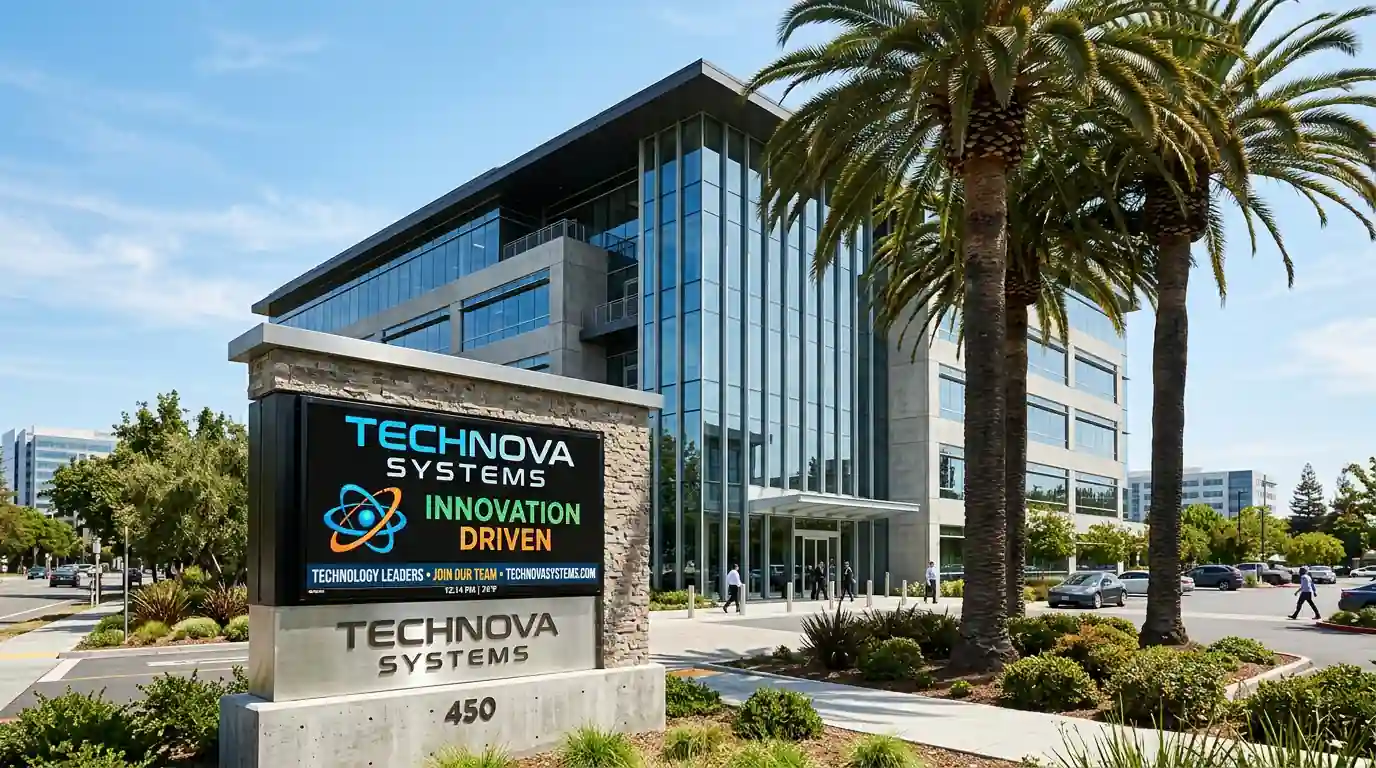
“Digital signage” gets used loosely. Some business owners mean a full programmable LED display that changes content throughout the day. Others mean any sign that lights up at night. Those are very different products with very different costs, permit requirements, and use cases — and mixing them up leads to either an underwhelming sign or an unnecessary permit headache.
Here’s the actual distinction, and how to tell which one fits your business.
Two Different Categories, Often Confused
Traditional illuminated signs — LED channel letters, halo-lit dimensional letters, backlit cabinet signs — use LEDs as a light source, but the message itself is fixed. Your business name and logo are built into the sign. The LEDs make it visible at night; they don’t make it programmable.
True digital signage — electronic message centers (EMCs) — are full LED display panels that show changing text, graphics, or full-color content. You update the message remotely, whenever you want: hours today, a sale this week, an event next month.
Both fall under “LED signs” as a category. Only one of them is actually digital in the sense most people mean when they ask about it.
Why the Difference Matters for Your Decision
Cost. A static LED channel letter sign is priced like any illuminated sign — fabrication, electrical, installation. An EMC is a different scale of investment: you’re buying a display panel, controller hardware, and ongoing software access for content updates. If a business owner expects channel-letter pricing and gets an EMC quote, the gap is significant.
Permit complexity. This is where the two categories diverge the most. A standard illuminated sign goes through San Jose’s normal sign permit process — size, placement, electrical sign-off. An EMC adds a separate layer: the city regulates animation speed, brightness levels (including automatic dimming at night), and how often content is allowed to change. Some zoning districts restrict or prohibit EMCs entirely, particularly in historic overlay zones and certain residential-adjacent commercial corridors. We handle EMC permit submittals through SJPermits.org, but it’s a real factor in timeline and feasibility that doesn’t apply to a standard channel letter sign.
Maintenance and lifespan. A static LED sign has almost no ongoing maintenance — the LEDs themselves are rated for 50,000+ hours, meaning a decade or more before any attention is needed. An EMC has more components: the display panel, the controller, the software platform for content updates. More capability means more to maintain.
What it actually communicates. A static sign identifies your business, consistently, day and night. An EMC can do that and also promote a weekly special, display the time and temperature, or count down to an event — but only if someone is actually updating the content. An EMC with stale information looks worse than no digital sign at all.
Who Actually Needs an EMC
Electronic message centers earn their cost when content genuinely changes often enough to justify it:
- Churches and schools — weekly service times, event schedules, community announcements that change every few days
- Auto dealerships — pricing, inventory promotions, seasonal offers
- Gas stations and convenience retailers — fuel pricing that legally needs to update daily
- Medical and healthcare campuses — wayfinding to specific buildings or departments across a multi-building site
- Restaurants with frequent specials — daily or weekly menu changes worth highlighting
If your messaging is essentially static — your business name, maybe a tagline — an EMC is paying for capability you won’t use. A well-designed illuminated channel letter or halo-lit sign delivers better visual quality and a lower total cost for that situation.
Who’s Better Served by a Traditional Illuminated Sign
Most San Jose storefronts, offices, and retail locations fall here. If your core need is “be visible and legible day and night with consistent branding,” a static LED sign does that job at a fraction of the cost and complexity of an EMC — no animation permit review, no content management, no controller hardware to maintain.
Channel letters, halo-lit dimensional letters, and illuminated cabinet signs all fall into this category. They’re the right call for the large majority of businesses that come to us asking about “LED signs” or “digital signs” without a specific need for changing content.
How to Decide
A few questions usually settle it:
- Does your messaging actually change weekly or more often — not “might someday,” but does it currently?
- Is there someone on your team who will own keeping the content updated?
- Does your zoning district even allow an EMC? (Some don’t — worth checking before getting attached to the idea.)
- Is the budget difference between a static sign and an EMC something you’ve actually compared, or assumed?
If you’re not sure, we’ll walk through it during a site assessment. Most of the time, the answer becomes obvious once you look at how often the messaging would realistically change.
Not sure which type fits your building and budget? Get a free quote → and we’ll help you figure out whether you need a static illuminated sign or a true EMC. Full details on our LED signs in San Jose.