
Medical office buildings have a wayfinding problem most other commercial properties don’t: a dozen or more independent practices sharing one address, and patients — often anxious, sometimes running late — who need to find the right suite the first time. Forest Avenue Medical Center in San Jose is exactly that kind of property, and the signage program needed to solve for it directly.
The Project
At 2100 Forest Ave., more than a dozen tenants — surgeons, dermatologists, an endoscopy center, LabCorp, an acupuncture clinic, and more — share a single medical office campus. The signage program needed to do two things: identify the building clearly from the street, and help visitors locate a specific practice once they’ve arrived, without relying on staff to give directions every time.
Directional Signage
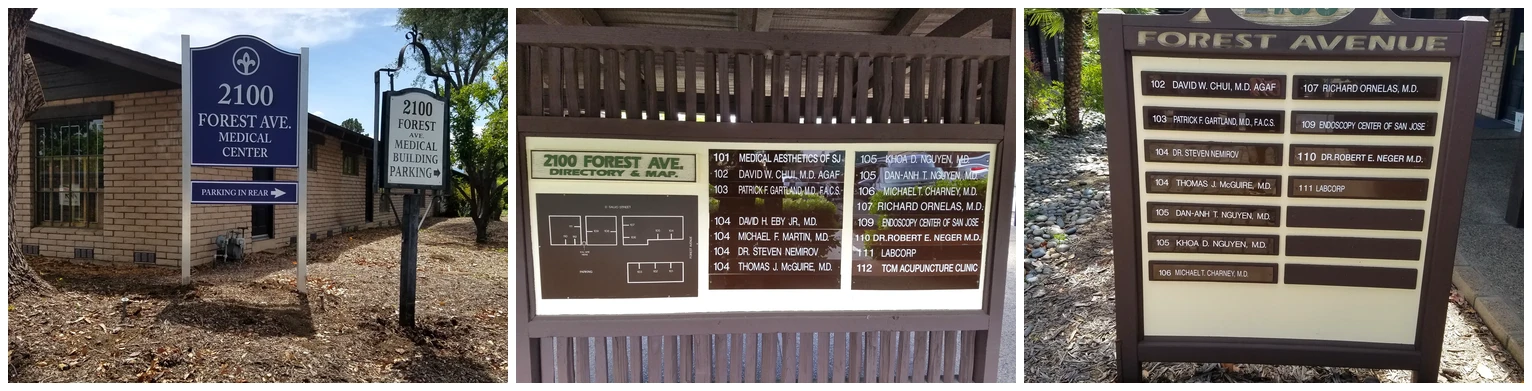
At the building entrance, a post-mounted directional sign identifies “2100 Forest Ave. Medical Center” with a “Parking in Rear” arrow directing traffic to the lot. A second hanging sign nearby repeats the address and points toward medical building parking specifically. Two signs, two slightly different jobs — one confirms a visitor has found the right building, the other gets their car parked without a lap around the block.
Tenant Directory Boards
The bulk of the wayfinding work happens on the tenant directory boards. Each practice is listed by suite number alongside the physician or business name — Medical Aesthetics of SJ, David W. Chui M.D., Patrick F. Gartland M.D., LabCorp, Endoscopy Center of San Jose, TCM Acupuncture Clinic, and more — with a site map showing building layout and a “you are here” marker.
Directory boards like this need to hold up to something most signage doesn’t: frequent updates. Medical tenants change more often than a typical office building — practices close, physicians relocate, new specialists move in. A modular panel system where individual name strips can be swapped without refabricating the whole board keeps the directory accurate without a full sign replacement every time a suite changes hands.
What Made This One Work
Wayfinding built for how patients actually navigate. A directional sign gets someone to the building and the parking lot; a directory board gets them to the specific suite. Neither one works alone in a multi-tenant property this size.
Planning for turnover from the start. Medical office tenant rosters change. A directory system designed with swappable individual panels, rather than one fixed printed board, means updates are fast and don’t require redesigning the whole sign every time a tenant changes.
Legibility at a glance. With a dozen-plus tenants on one board, clear suite numbering and consistent formatting matter more than decoration — a patient scanning the board under time pressure needs to find their listing in seconds, not study it.
If you manage a multi-tenant medical office, professional building, or business park that needs directional signage and a tenant directory system that’s actually easy to keep current, that’s exactly the kind of project we like taking on.
Clear Line Signs designs, fabricates, and installs directional signage, tenant directory boards, and wayfinding systems for medical office buildings and multi-tenant commercial properties across San Jose and the greater Bay Area. Get a free quote for your project.