
Every time a tenant moves out of a Silicon Valley office building, somebody has to deal with the signs. The suite plaque outside the door. The line on the lobby directory. The room IDs inside, if the space had any branding. Multiply that by a building with normal turnover, and signage becomes a recurring line item nobody budgeted for.
Vista System’s modular sign frames were built around solving exactly this problem. Here is how it works, and what it actually means for a property manager’s bottom line.
The Old Way: Replace the Whole Sign
In a conventional sign setup, the graphic is permanently bonded to the sign face — printed, engraved, or laminated directly onto the substrate. When the tenant changes, the entire sign comes down. A new one gets designed, fabricated, and installed in its place. For a single suite plaque, that might run $150–$300 per sign once you account for fabrication and a service call. For a lobby directory with 20 tenant lines, replacing the whole directory panel for one tenant change is even more wasteful — you are remaking 19 lines that did not change.
The Vista Way: Swap the Insert
Vista’s modular families — Nova, Square, Sharp, and the original Vista frame — all work on the same principle. The aluminum frame is permanent and mounts to the wall once. The graphic itself is a separate insert: a thin printed panel that slides, clips, or snaps into the frame.
When a tenant changes, you do not touch the frame. You print a new insert — often on standard photo paper or thin acrylic, depending on the system — and swap it in. No tools required on several of the systems; Vista Nova and Vista, for example, use a suction-cup tool to lift the existing graphic and drop in the new one in under a minute.
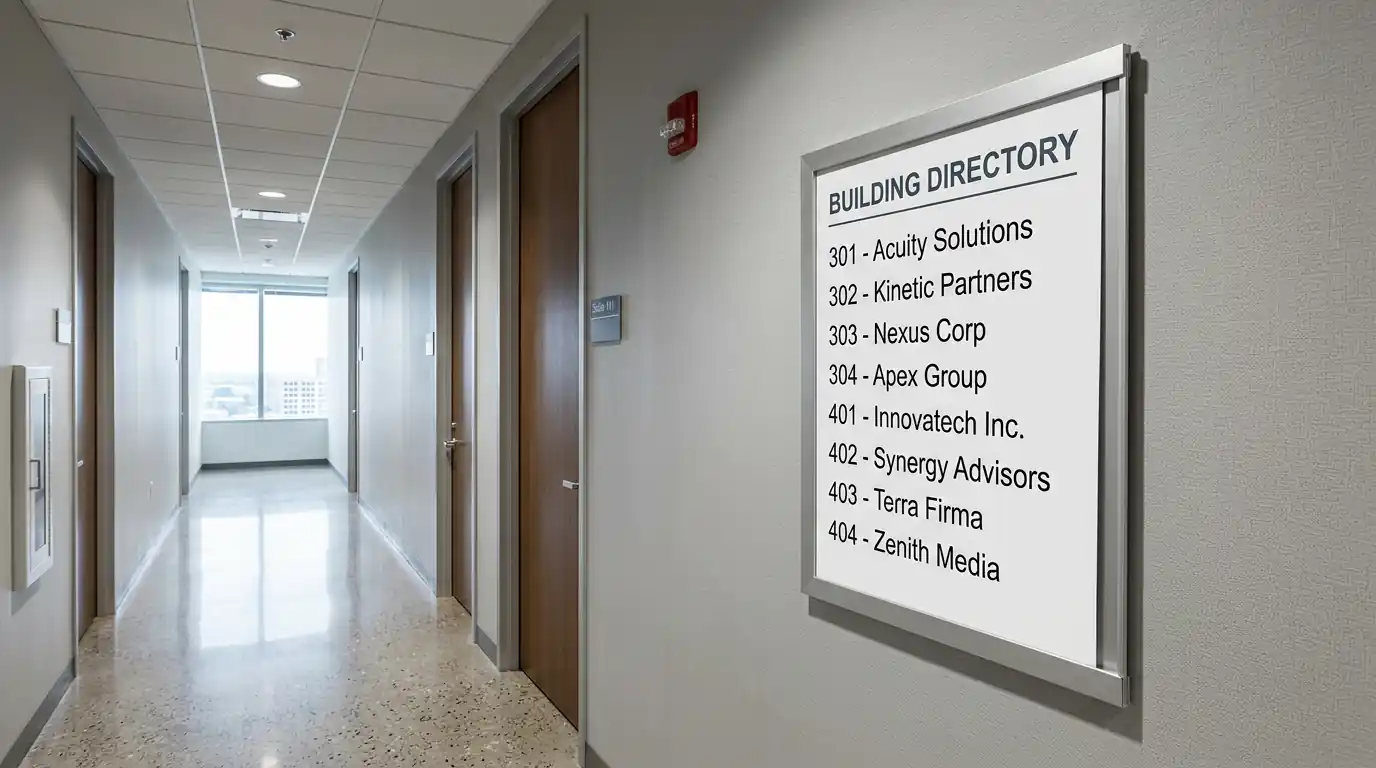
For directories, the same logic applies at scale. A Vista directory frame holds individual tenant strips. When tenant #14 moves out and a new tenant moves in, you reprint strip #14 and swap it — the other 19 strips, and the frame itself, are untouched.
What This Actually Saves
The math is straightforward. A new insert print typically costs somewhere in the $15–$40 range depending on size and material, versus $150–$300+ for a full sign replacement with fabrication and an install visit. Over a building with regular turnover — and in Silicon Valley, “regular” can mean multiple tenant changes per year across a multi-tenant property — that difference compounds quickly.
There is also a speed advantage that matters operationally. A new insert can often be turned around same-day or next-day. A full sign replacement involves design approval, fabrication lead time, and scheduling an installer — frequently a week or more. If a new tenant is moving in on a Monday and wants their name on the directory and suite sign, modular inserts are the difference between “done before they arrive” and “we will get to it next week.”
Where This Fits in a Building’s Sign System
Modular frames make the most sense for anything tied to a name, a department, or a use that can change: suite plaques, tenant directories, conference room IDs in shared or co-working spaces, and floor directories in multi-tenant buildings. They make less sense for permanent wayfinding — exit signs, restroom signs, building address numbers — where the graphic never changes and a conventional sign is simpler and often less expensive upfront.
A well-planned wayfinding system usually mixes both: permanent signs for the elements that never change, modular Vista frames for everything that might.
Getting Started
If you manage a multi-tenant building in the South Bay and want to see whether modular signage makes sense for your property, we can walk the space, identify which signs are good candidates for Vista frames, and put together a sign schedule — including a rough comparison of modular versus conventional costs for your specific building.
For the full Vista System product overview, see our Vista System wayfinding page, or contact us directly to schedule a walkthrough.
Frequently Asked Questions
Can any existing sign be converted to a modular insert system? Most wall-mounted signs — suite plaques, directories, and room IDs — can be replaced with a Vista modular frame during a retrofit. The frame is a new install, but once it’s up, every future graphic change is just an insert swap.
How much does a Vista insert replacement actually cost compared to a new sign? A new insert typically runs $15–$40 depending on size and material, versus $150–$300+ for a full sign replacement with fabrication and an install visit. The savings come from skipping fabrication and a service call entirely.
Do modular signs look different from permanent signs? No. Vista’s modular frames are designed to look like standard architectural signage — the insert mechanism is built into the frame edge and isn’t noticeable from a normal viewing distance.
What happens to the Vista frame if we eventually want to remove it? The frame unmounts the same way any wall sign would. There’s no special removal process — it’s standard hardware into drywall or a similar substrate.