
Not every sign project happens inside a lobby. Some happen 20 feet off the ground on a concrete BART structure, with a boom lift and a crew working against a transit agency’s schedule.
The VTA Milpitas BART station dimensional letter installation was one of those projects — and it is a good example of what large-format painted acrylic letters look like when the substrate is raw concrete and the client is a public transit authority.
The Project
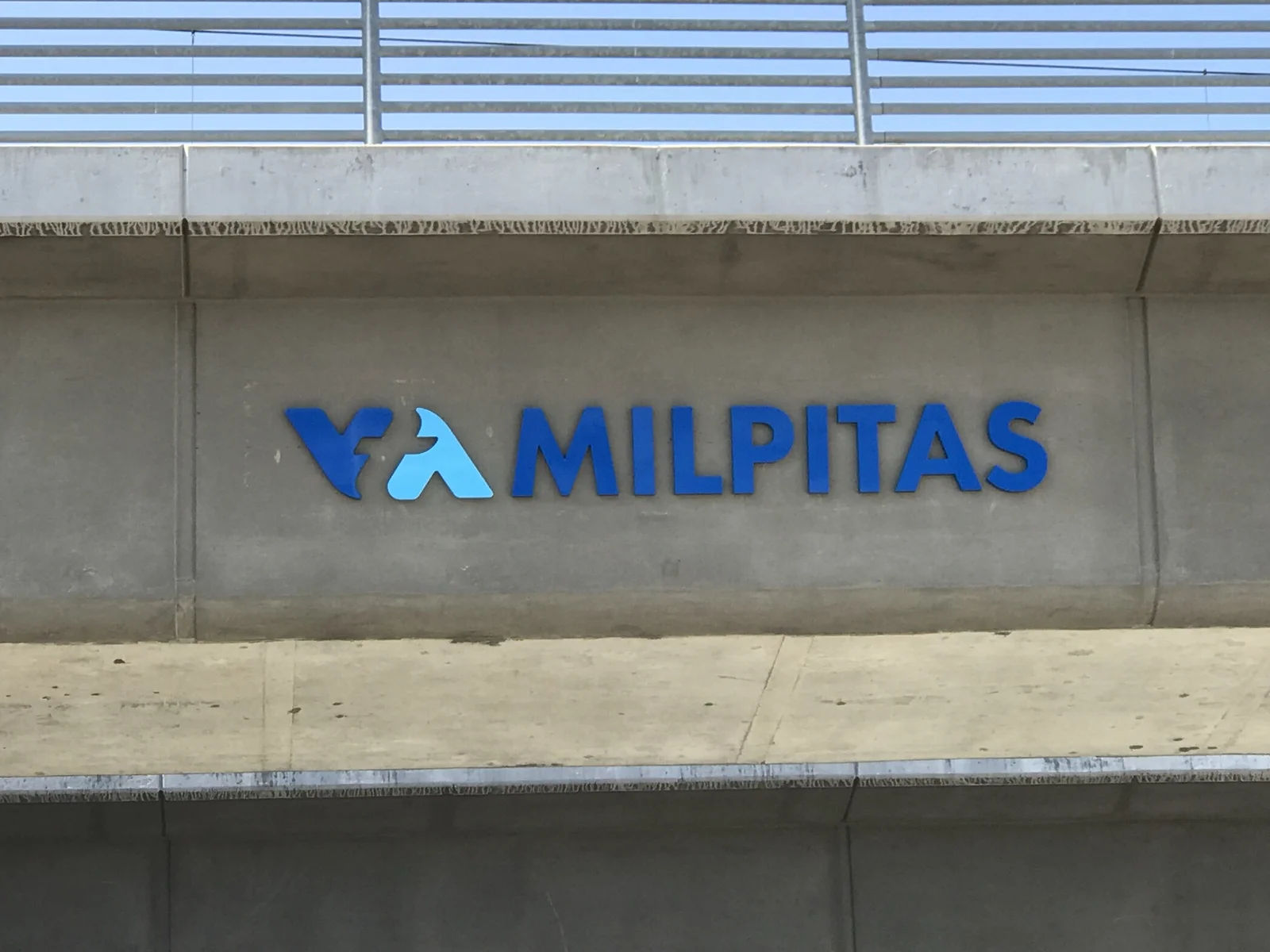
VTA needed station identification letters installed on the exterior concrete face of the Milpitas BART station structure — the visible concrete beam running along the track level that passengers and drivers see from the street and the platform.
The spec called for 4-inch painted acrylic letters, fabricated to match VTA’s brand colors and stud-mounted directly into the concrete face. No raceway, no cabinet, no backer panel — just clean dimensional letters sitting off the surface on threaded studs, the way they look on a finished building when done right.
Fabrication
The letters were cut from acrylic sheet stock and painted to VTA’s specified colors — the blue field letters and the two-tone VTA logo mark. Painted acrylic is the right material choice for this kind of exterior application: the paint is applied to the back face of the acrylic (called second-surface painting), so the color is protected by the acrylic itself and won’t chip or fade from UV exposure the way a surface-painted material would.
Stud mounting required precision drilling of the letter backs before delivery to site — each stud location mapped to a template so the installation crew could drill the concrete at exact spacing and drop the letters in cleanly.
Installation
Getting letters onto a concrete BART structure at height requires a boom lift and coordination with VTA’s site access schedule. Our crew worked from the lift to drill the concrete anchor points, set the studs, and hang each letter to level. On a raw concrete face with no reference lines, getting dimensional letters to read straight is entirely on the installer — there is no margin for a crooked run at that scale.
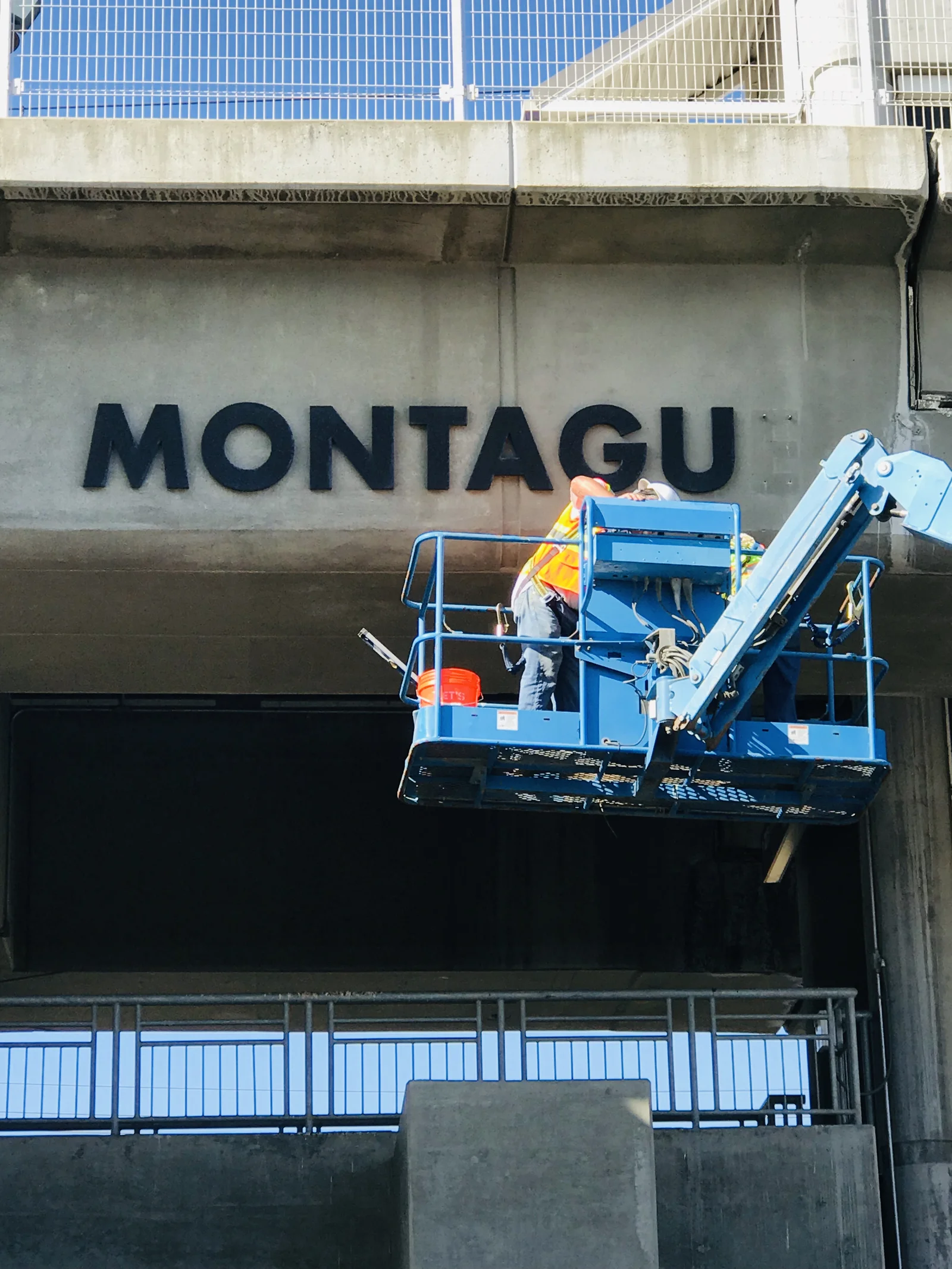
The finished installation delivers clean, professional station identification that reads from the street, from the parking structure, and from the platform — exactly what you want from station signage.
Why Painted Acrylic for Exterior Use
Acrylic is commonly thought of as an interior material — lobby signs, reception walls, office doors. But painted acrylic letters perform well in exterior applications when specified correctly:
- Second-surface painting protects color from UV degradation and surface abrasion
- Acrylic sheet is dimensionally stable — it doesn’t rust, corrode, or delaminate the way some composite materials do
- Stud mounting keeps the letters off the wall surface, preventing moisture trapping behind the sign
- Weight is manageable for overhead installation compared to cast aluminum or steel letters at the same size
For a transit authority project where the letters need to look sharp for 20+ years with minimal maintenance, painted acrylic on studs is a practical, durable specification.
Working on Public Infrastructure Projects
Transit authority and public infrastructure sign projects have a different cadence than a typical commercial installation. Submittals go through a procurement process. Site access is coordinated with the agency’s operations schedule. The work has to meet the spec exactly — there is no “close enough” on a public contract.
We have done this kind of work before, and we understand what it takes to deliver cleanly on a public-sector job. If you are a contractor, facilities manager, or agency staff working on a project that includes dimensional letter signage on concrete, steel, or other structural substrates — and you need a sign company that can spec, fabricate, and install to a tight standard — contact us to discuss the project.
More examples of our dimensional letter work are on the dimensional letters page and the portfolio.